


I get this question a lot.
Every year around Passover, someone sends me a message: “I always thought Jesus died on Passover. Doesn’t that mean the Last Supper was just a regular meal the night before?”
Or: “My pastor said the Last Supper couldn’t have been Passover because John’s Gospel puts it on a different day.”
Or sometimes: “I just assumed it was a Passover meal. Is there actually a debate about this?”
Yes. There is a debate. It’s been going on for a long time, and serious scholars land on different sides of it. I understand why the question comes up, and I understand why people feel strongly about their answer.
But strong feelings are not the same thing as careful interpretation.
Here’s what I want to do in this article: lay out the evidence, present the tension honestly, and show you why I land where I land—without pretending every difficulty has been erased.
This is not a salvation issue. It never has been.
If you disagree with me at the end, we’re still family. But if you’re genuinely curious and want to understand the question, this is my attempt to give you a thorough, honest answer in one place.
Where I Stand
Let me tell you my conclusion up front so you know where this is going.
The Synoptic Gospels clearly present the Last Supper as a Passover meal. Paul treats it as a Passover meal. John introduces chronological tension in a few key verses, but he does not clearly say, “This was not a Passover meal.”
Even if one thinks the chronology is difficult to harmonize in every detail, the Gospel tradition—and the apostolic tradition after it—presents Jesus’ final meal in a deeply Passover-shaped frame.
This matters because when Jesus says “Do this in remembrance of me,” the “this” is not a random Thursday dinner. It’s Passover.
The Synoptics Are Not Subtle Here
Let’s start with the strongest evidence. Not the controversial stuff—the clear stuff.
Matthew, Mark, and Luke all narrate the events leading up to Jesus’ final meal, and they do it in explicitly Passover language.
In Matthew 26:17–19:
Now on the first day of Unleavened Bread the disciples came to Jesus, saying, “Where will you have us prepare for you to eat the Passover?” He said, “Go into the city to a certain man and say to him, ‘The Teacher says, my time is at hand. I will keep the Passover at your house with my disciples.’” And the disciples did as Jesus had directed them, and they prepared the Passover.
Mark 14:12 adds something significant:
And on the first day of Unleavened Bread, when they sacrificed the Passover lamb, his disciples said to him, “Where will you have us go and prepare for you to eat the Passover?”
And Luke 22:7–8:
Then came the day of Unleavened Bread, on which the Passover lamb had to be sacrificed. So Jesus sent Peter and John, saying, “Go and prepare the Passover for us, that we may eat it.”
The word Passover (Greek: pascha) appears twelve times across the Synoptic accounts. Five of those come from the lips of Jesus himself. This is not vague atmosphere language. It is direct, repeated, narrative framing.
If the Synoptic writers did not intend for readers to understand this as a Passover meal, they are spectacularly misleading.
This Is Not Being Narrated Like a Random Farewell Dinner
The explicit Synoptic statements are the anchor. But they are not the only evidence.
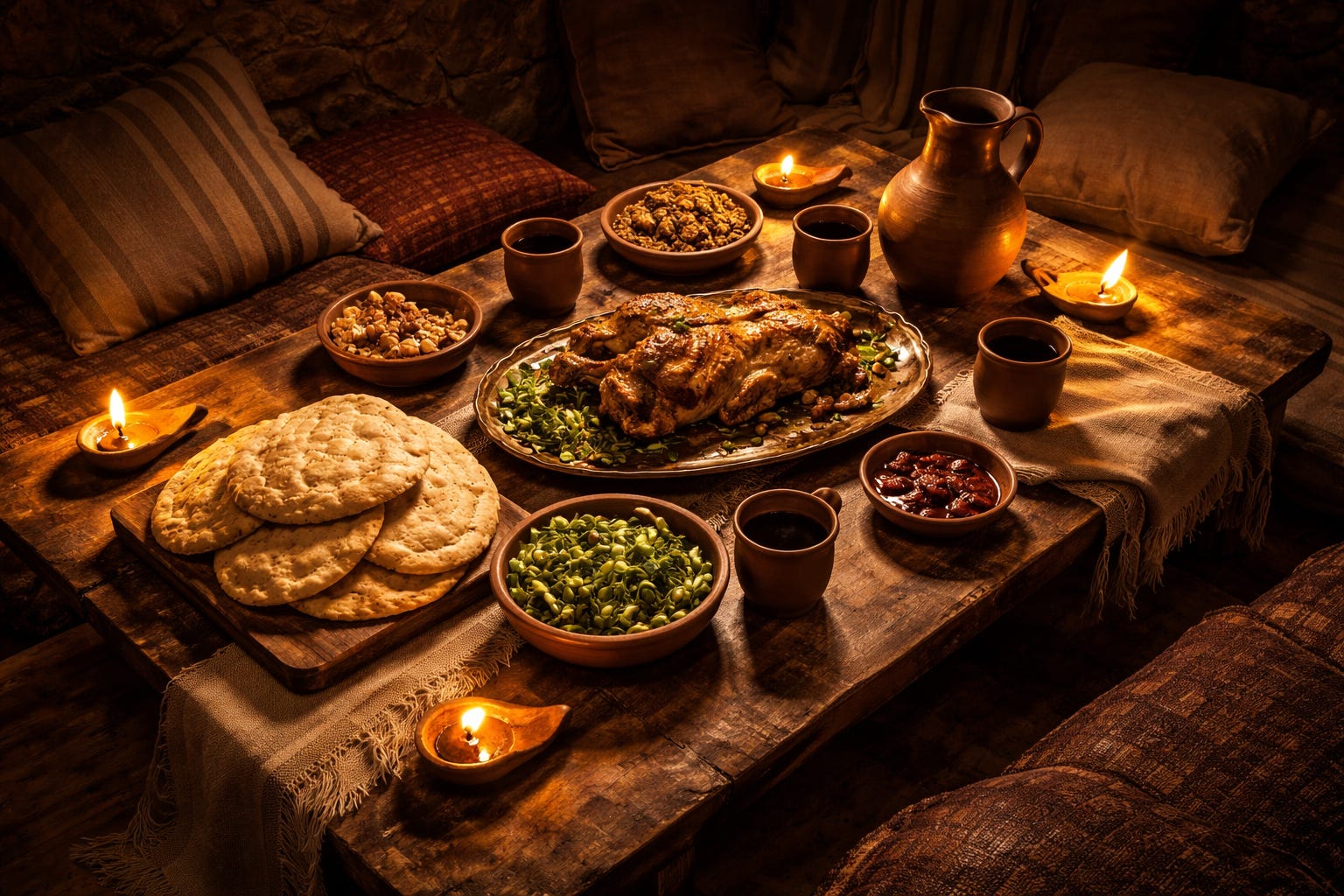
The meal itself, as narrated across the Gospels, has multiple features that are specifically Passover-shaped—features that would not be present at an ordinary first-century dinner.
The meal is prepared in Jerusalem, which was required for Passover.
It is eaten at night—normal meals in the first century were eaten during the day; the Passover was the meal eaten at night.
The group reclines—a Passover practice in the Second Temple period, not typical of ordinary meals.
Bread and wine are interpreted within the meal—the head of the household was expected to explain the meaning of elements of the Passover. Gamaliel himself taught that if you don’t interpret the elements of the Passover, the obligation is not fulfilled.
They sing a hymn before going out—consistent with the Hallel Psalms sung at the conclusion of the Passover Seder. Nowhere else in the Gospels is a hymn mentioned after a meal.
Jesus remains within the bounds of Jerusalem—staying on the Mount of Olives rather than returning to Bethany, as Passover required staying within the city limits.
Then there’s Judas. When Jesus identifies his betrayer and Judas leaves in a hurry, the disciples assume he is either buying last-minute supplies for the feast or giving money to the poor. Both are approved Passover-night practices (Mishnah Shabbat 23:1).
And here’s what’s important: neither assumption makes any sense if the feast is still a full day away. Why would Judas need to urgently run out in the middle of the night to buy supplies if he had all the next day to do it?
Any one of these details by itself might not settle the matter.
Together, they create a picture that is unmistakably Passover.
Paul Doesn’t Debate This—He Assumes It
Before we ever get to the controversy with John’s Gospel, there’s another witness we need to hear from: Paul.
Paul writes to the Corinthian church—mostly former Gentiles—and uses Passover language as if it is the natural framework for understanding Jesus’ death.
In 1 Corinthians 5:7–8:
Cleanse out the old leaven, that you may be a new lump, as you really are unleavened. For Messiah, our pascha, has been sacrificed. Therefore let us celebrate the festival, not with the old leaven, the leaven of malice and evil, but with the unleavened bread of sincerity and truth.
Notice: Paul does not say, “Therefore we no longer keep those old feasts.” He says let us celebrate the festival. And the word he uses for Jesus is pascha—which in first-century usage always referred to a meal where a sacrificed Passover lamb was present.
In 1 Corinthians 10:16–18, Paul connects the cup of blessing and the bread directly to participation in the body and blood of Messiah. Then he draws an explicit parallel:
Consider the people of Israel: are not those who eat the sacrifices participants in the altar?
Paul is saying: the bread and the cup are how we participate in Jesus’ sacrifice. Just as Israel participated in their sacrifices by eating the sacrificial meal, so we participate in the sacrifice of Jesus through the bread and wine of the Passover.
And in 1 Corinthians 11:23–26, Paul passes down the tradition of the bread and the cup—language that maps directly onto the Passover Seder. He frames it as something received and handed on. This isn’t Paul’s innovation. It’s apostolic tradition, embedded in the earliest layer of the Christian movement.
Paul isn’t arguing for the Passover connection. He assumes it.
That matters.
First-Century Terminology Is Not as Neat as We Want It to Be
Before we get to John’s Gospel and the tension it introduces, we need to understand something about how Passover language actually worked in the first century.
Modern readers tend to assume clean, fixed definitions: “Passover” means one thing, “Unleavened Bread” means another, and these terms should never overlap.
But that’s not how first-century Jewish usage worked.
The word pesach (Hebrew) / pascha (Greek and Aramaic) had at least four distinct uses:
it could refer to the lamb slaughtered on Nisan 14
it could refer to the day of the Passover slaughter itself
it could refer to the entire festival of Passover and Unleavened Bread combined
and it could refer to the peace offerings eaten throughout the festival week.
We see this right in Scripture.
In Deuteronomy 16:2, the text says to offer the pesach “from the flock or the herd”—bulls are being called pesach. In 2 Chronicles 35:7–9, both lambs and bulls are called pesachim (plural of pesach).
These weren’t just the Nisan 14 lamb. They were the festival offerings eaten throughout the week.
Luke 22:1 even explains this for his readers: “Now the feast of Unleavened Bread drew near, which is called the Passover.” Luke knows his audience may not realize the terms had become interchangeable. Josephus does the same thing, using “Passover” and “Unleavened Bread” interchangeably for the entire festival.

One more critical point: there is no evidence of a lambless Passover meal before the destruction of the temple in 70 AD. When first-century texts speak of “eating the Passover,” they always mean a meal at which a sacrificed Passover lamb is present.
The lambless Seder is a post-destruction adaptation—a necessary one after the temple fell, but not something that existed in Jesus’ day. Applying the later concept of a lambless Passover to the Gospels is anachronistic.
This matters enormously when we turn to John’s Gospel. Because the words John uses may not mean what modern readers assume they mean.
John Is the Reason This Debate Exists
Let’s be honest. If we only had Matthew, Mark, and Luke, no one would be debating whether the Last Supper was a Passover meal. The tension comes from John.
Three verses create the problem:
John 13:1 — “Now before the feast of the Passover, when Jesus knew that his hour had come…”
This sounds to many readers like the supper occurs before the feast of Passover.
John 18:28 — “Then they led Jesus from the house of Caiaphas to the governor’s headquarters. It was early morning. They themselves did not enter the governor’s headquarters, so that they would not be defiled, but could eat the Passover.”
This implies the religious leaders have not yet eaten the Passover, even though Jesus’ meal has already taken place.
John 19:14 — “Now it was the day of Preparation of the Passover.”
This seems to place the crucifixion on the day before Passover.
These are real tensions. I am not going to pretend they don’t exist. If someone tells you there is no difficulty between John and the Synoptics here, they are not reading carefully enough.
But tension is not the same as contradiction. And the case for John overturning the Synoptic presentation is weaker than most people realize.
John Introduces Tension, but Not a Knockout Blow
Here’s why I do not think John cancels the Synoptic presentation.
First, John’s Gospel always has a different angle.
John’s Gospel differs from the Synoptics in many ways.
He places the cleansing of the temple at the beginning of Jesus’ ministry rather than the final week.
He presents a three-year ministry, not the compressed timeline of the Synoptics.
He narrates details at the empty tomb differently.
He identifies Judas differently.
These are not signs that John is “wrong”—they are signs that John is doing something different with the material.
Most importantly for our question: John deemphasizes the Last Supper itself.
He doesn’t narrate the bread-and-cup institution at all. Instead, he uses the supper as a platform for extended discourse—the farewell speech, the foot washing, the promise of the Holy Spirit.
John actually moves the “eat my flesh / drink my blood” teaching to chapter 6, a completely different Passover context.
John is not primarily interested in narrating the Seder. He presupposes his readers already know the Synoptic accounts.
Example: In the Garden of Gethsemane, Jesus says, “Am I not to drink the cup which my Father has given me?” But John never narrates the cup institution at the supper or the prayer about the cup in Gethsemane. The reference only makes sense if John expects readers to already know the Synoptic story.
Craig Keener, a leading New Testament scholar, proposes that John may have developed his material the way Jewish haggadists or targumists did—”faithful to his tradition while expounding on its meaning for his own generation.”
John is reshaping, not contradicting.
Second, the specific verses are less decisive than they appear.
“Eat the Passover” in John 18:28 does not have to mean the Seder meal itself.
Given the broader usage of pascha we’ve already established, it can plausibly refer to eating the festival offerings (the chagigah peace offerings) eaten throughout the week. The religious leaders may have already eaten the Passover lamb on the 14th—just as the Synoptics say—and are now concerned about eating the ongoing festival sacrifices.
“The day of Preparation of the Passover” in John 19:14 is the most debated phrase. But here we need to understand how first-century Jews named their days.
First century Jews did not name the days of the week. They simply called them Day 1, Day 2, Day 3, and so on.
There were only two named days: the seventh day was called “the Sabbath” (Shabbat), and by the first century, the sixth day had come to be called “the Preparation” (Greek: paraskeue)—that is, the day of preparation for the Sabbath.
We see this confirmed in Josephus (Antiquities 16.163–164), where paraskeue is used to refer to the day before the Sabbath.
Also, the Didache (8:1), one of the earliest Christian documents, instructs fasting on “the fourth day and the Preparation”—Wednesday and Friday.
Mark 15:42 explicitly glosses the term for his readers: “the day of Preparation, that is, the day before the Sabbath.”
If paraskeue was already functioning as the name for Friday, then “the Preparation of the Passover” most naturally reads as “Friday of Passover week”—not “the day before the Passover meal.”
This reading harmonizes John with the Synoptics rather than contradicting them.
I am not claiming this resolves every ambiguity. I am claiming that John’s language is less decisive against the Synoptics than most people assume.
You can read John’s key verses in more than one way—and the way that has John flatly contradicting the Synoptics is not the only way, or even the most natural way, once you understand first-century terminology.
Metaphors Have Limits—and That’s Okay
Before we go further, I need to address an assumption that drives a lot of this debate: the idea that Jesus had to die at the exact hour the Passover lambs were being slaughtered in order to be “the Passover Lamb.”
This is a common theological claim. But it is stronger in theology systems than it is in the actual biblical text.
The Gospels explicitly date the meal in Passover terms—twelve uses of pascha, five from Jesus’ own lips. They do not equally explicitly date the crucifixion as “the moment the Passover lambs were being slaughtered.” That connection is inferred, not stated.
And here’s the thing about metaphors: they have limitations.
Jesus was not a literal lamb.
He didn’t have wool or hooves.
The Passover lamb was never tortured—Jesus was.
The Passover lamb had to be a year-old male from the flock—Jesus was a thirty-something human being.
We accept these limitations without any trouble.
But there’s an even stronger example: The author of Hebrews connects Jesus with the Yom Kippur goat whose blood was brought into the Holy of Holies.
Yet Jesus did not die on Yom Kippur.
You couldn’t kill the Yom Kippur goat six months early and save the blood—it had to be done on the day.
And yet no one objects to the metaphorical connection between Jesus and the Yom Kippur sacrifice.
If a metaphor can connect Jesus to Yom Kippur without requiring him to die on Yom Kippur, then the Passover lamb metaphor does not require him to die at the exact hour of the lamb slaughter, either.
Symbolism matters. But symbolism should not be forced beyond what the text clearly says.
What About Alternate Passover-Day Theories?
Some scholars have proposed creative harmonizations: an early “practice Passover,” a distinct Galilean reckoning, a Pharisaic versus Sadducean date difference, or an Essene calendar solution.
These proposals are interesting thought experiments. But they share a common problem: they are not stated by the Gospel texts themselves.
More importantly, no clear first-century evidence has been demonstrated for an officially recognized alternate Passover date in Jerusalem in which lambs were lawfully sacrificed a day early.
The priesthood controlled the timing of the slaughter.
An early Passover sacrifice would have required unlawful temple action—and there is no evidence the temple authorities permitted it.
The Synoptics already tell us how they want us to understand the meal. We do not need to invent a mechanism the texts themselves never mention.
Interesting proposals are not the same thing as historically established practice.
This Matters Because Jesus Is Reframing Passover Around Himself
Now we arrive at the part of this article that matters most. Not the chronology debate—the theology underneath it.
To understand why the Passover connection is so important, you need to understand what a sacrifice actually is.
A sacrifice in the biblical world is not merely a death. It is the death plus the manipulation of the blood plus the consumption of the flesh.
All three had to happen.
In Exodus 12, the instruction for killing the animal takes up one line. Then comes extensive instruction about putting the blood on the doorposts and eating the flesh with unleavened bread and bitter herbs.
If the Israelites had only killed the lamb in Egypt but not applied the blood and eaten the flesh, they would not have been saved.
This is why Paul writes in 1 Corinthians 10:18: “Are not those who eat the sacrifices participants in the altar?” Eating is how you participate in the sacrifice.
Eating is how you receive its benefits.
Now hold that in your mind and listen to Jesus’ words again:
“This is my body, given for you.”
“This is my blood of the covenant, poured out for many for the forgiveness of sins.”
“Do this in remembrance of me.”
Jesus is not offering an abstract theological statement. He is giving his disciples a meal. And the meal he is giving them is a Passover meal.
The bread and wine are how we participate in his sacrifice—just as Israel participated in the Passover sacrifice by eating the lamb.
“Do this in remembrance of me” is not spoken over a random dinner. It is spoken over the Passover.
And in first-century Passover practice, remembrance was not passive nostalgia. The Passover Haggadah retold the Exodus story as if the participants themselves had gone through it. It was participatory identity. You didn’t just remember the Exodus—you entered it. You declared that you, too, were brought out of Egypt.
Jesus takes that same framework and weaves his own story into Israel’s story.
N. T. Wright puts it well: the Passover looked back to the Exodus and forward to the coming of the kingdom. Jesus intended this meal to symbolize the new Exodus—the arrival of the kingdom through his own fate.
When we do Passover in remembrance of him, we are connecting Israel’s past, Jesus’ sacrifice, and the coming kingdom into one.
That is what is at stake in this debate.
Not a calendar argument. A meal that carries the weight of the entire biblical story.
The Disciples Didn’t Stop Doing This After the Resurrection
One more piece of historical evidence worth mentioning.
The earliest church continued to observe Passover. They called it Pascha. This isn’t disputed.
What is sometimes debated is the timing.
In the mid-second century, a dispute arose between Polycrates (bishop in Asia Minor, a disciple of Polycarp, who was himself a disciple of the apostle John) and the bishop of Rome. Polycrates insisted on observing Pascha on Nisan 14—the biblical date—because that was the tradition passed down from the apostles. Rome preferred the following Sunday, to align with the resurrection.
But notice: the debate was about which day to observe, not whether to observe.
Both sides assumed Christians observed Pascha. The tradition that stretched from John the apostle through Polycarp through Polycrates maintained the 14th of Nisan—”according to the gospel, deviating in no respect.”
This was not a later innovation. It was a continuation of what Jesus established at that meal.
I’ve written more about this in a separate article: Did Early Christians Keep Passover?
What I Am and Am Not Claiming
I want to be precise here, because precision builds trust.
I am claiming:
The Synoptics plainly present the meal as Passover.
Paul treats it as Passover and tells believers to celebrate accordingly.
John creates tension but does not force a non-Passover reading.
The meal’s theological meaning is profoundly Passover-shaped.
“Do this in remembrance of me” refers to a Passover meal, not a generic ritual.
I am not claiming:
Every chronological detail has zero difficulty.
All who disagree are foolish.
Every harmonization proposal is equally worthless.
John is simply “wrong” about the timeline.
You must agree with me to take Scripture seriously.
The Synoptics and Paul give us a clear, consistent picture. John complicates it.
But the complication does not erase the picture—and honest readers can acknowledge the tension without panicking.
Read the Gospels Carefully—and Don’t Let a Tension Erase the Bigger Picture
The easiest starting point is still the Synoptic presentation: explicit, repeated, and confirmed by Paul.
John complicates the picture. But not enough to erase the Passover framing.
The Last Supper is not a random meal with symbolic add-ons. It stands within the Exodus story, covenant memory, and redemption language. When we eat that bread and drink that cup at Passover, we are participating in something that reaches back to Egypt, centers on the cross, and stretches forward to the coming kingdom.
There is still more to explore here—particularly the fascinating question of the final cup.
Jesus tells his disciples he will not drink again of the fruit of the vine until the kingdom comes. What happens next, from Gethsemane to the cross, may be more connected to the Passover meal than most readers realize. I’ll be exploring that in a future article.
But for now, this much is clear:
Whatever one concludes about every chronological detail, the Gospels want us to see Jesus’ final meal through the lens of Passover—and they want us to keep doing it.
What are your thoughts? Does this change how you see the Last Supper? I’d love to hear from you in the comments.
I appreciate the time you took to read this article. If you were inspired by it, do me a favor and share it with just one person you know.
Addendum: What About “Three Days and Three Nights”?
This comes up often enough that it deserves a brief note, but it is a separate question from whether the Last Supper was a Passover meal.
Some readers use the “three days and three nights” language (Matthew 12:40) to argue for a Wednesday crucifixion and a non-standard Passover timeline. But the New Testament also uses “on the third day” language repeatedly (Matthew 16:21; 17:23; 20:19; Luke 24:7, 46; 1 Corinthians 15:4), which does not align with a rigid 72-hour reading.
Jewish idiom and inclusive reckoning matter here. In ancient Jewish usage, part of a day could count as a full day. Friday afternoon to Sunday morning—though not 72 hours—would have been understood as covering “three days.”
This is worth studying carefully. But it should not be used as a trump card against the Synoptic Passover framing of the Last Supper. The two questions are related but distinct.
Short FAQ
Was the Last Supper definitely a Passover seder in the full later rabbinic sense? Probably not in every later formalized detail. But the question is whether the Gospels portray it as Passover, and the Synoptics clearly do. The later rabbinic Seder developed further after the destruction of the temple.
Does John contradict the Synoptics? John creates real tension. But the relevant verses can be read in more than one way, and John’s Gospel differs from the Synoptics in many areas without anyone concluding the whole thing is unreliable.
Did Jesus have to die exactly when the lambs were being slain to be “the Passover Lamb”? That is a common theological claim, but it is not stated as directly in Scripture as many assume. Metaphors have limitations—and that includes this one.
What about Galilean or alternate-date theories? They are interesting harmonization proposals. But no clear first-century evidence has established an officially recognized alternate Passover date in Jerusalem that solves the issue.
Could the Last Supper have been a Passover meal without a lamb? There is no evidence of a lambless Passover meal before the destruction of the temple in 70 AD. In first-century usage, calling a meal “Passover” always implied a sacrificed lamb was present.
Doesn’t the Greek word artos mean leavened bread? If so, this couldn’t have been a Passover meal. No. Artos is the generic Greek word for bread—it can refer to leavened or unleavened bread depending on context. The clearest proof is in the Gospels themselves. In Luke 24:30, on the road to Emmaus, Jesus “took the artos and blessed and broke it.” This is the third day after the crucifixion—squarely during the Feast of Unleavened Bread, when no one would have been eating leavened bread. Yet Luke uses artos without hesitation. The Septuagint does the same thing: Deuteronomy 16:3 uses artos to describe the unleavened bread eaten at Passover. Josephus and Philo also use artos for unleavened bread. The argument that artos proves the bread was leavened simply does not hold up. It’s a generic term, and the context—not the word itself—determines whether the bread is leavened or unleavened.
Did the early church continue to observe Passover? Yes. They called it Pascha. The debate (the Quartodeciman controversy) was about which day to observe it—not whether to observe it. See: Did Early Christians Keep Passover?
Why does this matter at all? Because it affects how we understand Jesus’ words, covenant symbolism, remembrance, and the Exodus framework behind the meal. If “Do this in remembrance of me” was spoken over a Passover meal, it changes what “this” means—and what we are called to do.
Master Reference List
This article is based on my in-depth series, Do This in Remembrance of Me (7-part teaching series + abridged version), available for Faith of Messiah members (https://FaithofMessiah.com/join/)
The following is a list of references used in the full teaching series (not all used here)
Modern Scholarly Books
Joachim Jeremias, The Eucharistic Words of Jesus — in-depth analysis of the Gospel accounts of the Last Supper, Passover Seder connections, and objections to the meal being Passover
Brant Pitre, Jesus and the Last Supper — extensive treatment of the Last Supper and Passover connection
Brant Pitre, Jesus and the Jewish Roots of the Eucharist
Craig Keener, The Gospel of John: A Commentary (2 vols.) — on John’s targumic/haggadic approach to the Synoptic tradition
N. T. Wright, Jesus and the Victory of God — on Jesus’ prophetic actions with bread and cup and the new Exodus
N. T. Wright, commentary on the Lord’s Prayer (referenced for the manna/inaugurated eschatology connection)
Rabbi Abraham Bloch, The Biblical and Historical Background of Jewish Holy Days — section on Passover
David Instone-Brewer, Traditions of the Rabbis from the Era of the New Testament (multi-volume, ongoing) — analysis of which Mishnah/Tosefta traditions predate 70 AD
Harold Hoehner, Chronological Aspects of the Life of Christ — discussion of Wednesday/Thursday/Friday crucifixion theories
Marcus Borg and John Dominic Crossan, The Last Week: A Day-by-Day Account of Jesus’s Final Week in Jerusalem
Journal Articles
Percy Haywood, “The Time of the Last Supper,” Jewish Quarterly Review (1951) — on the timing of the meal, Sabbath-like restrictions on Nisan 15, and the ambiguity of the transitional hours between Nisan 14–15
Ancient Primary Sources
Greek Scripture
Septuagint (LXX) (~250 BC) — Lexham English Septuagint used; referenced for Greek translation choices, including artos for unleavened bread in Deuteronomy 16:3 and the use of paraskeue
Josephus (~93 AD)
Antiquities of the Jews 2.317 — the entire eight-day feast called “Unleavened Bread”
Antiquities 3.255 — the bread of the showbread/presence
Antiquities 14.21 (14.2.1) — “Passover” used for the whole festival
Antiquities 16.163–164 (16.vi.2) — paraskeue as the day before the Sabbath (i.e., Friday)
Antiquities 17.9.3 — “Passover” for the entire feast
Antiquities 18.29 — festival of Unleavened Bread called Passover
Philo of Alexandria (~50 AD)
Referenced for usage of artos for unleavened bread and general first-century Alexandrian Jewish practice
Dead Sea Scrolls (200 BC - 70 AD)
Referenced briefly for the Essene solar calendar and their separate festival dating
Book of Jubilees (~150 BC)
Referenced for second-century BC interpretation of Passover practices, including eating the Passover on the 15th
2 Baruch (70 AD - 120 AD)
2 Baruch 29:3, 6–8 — the Messiah will be revealed, and the treasury of manna will come down from on high
Mishnah (compiled ~200 AD; traditions potentially earlier)
Mishnah Pesachim 1.4 — removal of leaven
Mishnah Pesachim 5.1 — timing of the Passover sacrifice
Mishnah Pesachim 9.5 — pesach used for festival offerings
Mishnah Pesachim 10.1 — the Passover Seder
Mishnah Pesachim 10.7 — the four cups; no drinking between third and fourth cup
Mishnah Shabbat 23.1 — emergency purchases of necessities permitted on the weekly Sabbath
Mishnah Shabbat 23.5 — preparation of a body for burial on the Sabbath
Mishnah Sanhedrin 4.1 — prohibition of capital cases on the eve of Sabbath or festivals
Mishnah Zevakim 1.3 — discussion of improperly designated sacrifices
Mishnah Avot 5.6 — ten things created on the eve of the seventh day, including the manna
Tosefta (compiled ~200 AD but slightly after the Mishnah; traditions potentially earlier)
Tosefta Berakhot 1.1 — sacrificial time reckoning (sunrise to sunrise) vs. Sabbath reckoning (sunset to sunset)
Tosefta Shabbat 17.13 — attending to burial needs on the Sabbath
Tosefta Sanhedrin 11.7 — rebels and false prophets held until the festival and executed on the feast day (citing Deuteronomy 17:12–13)
Babylonian Talmud (compiled ~500 AD; some traditions potentially represent first century practice)
Babylonian Talmud, Rosh Hashanah 5a — pesach used for festival offerings
Babylonian Talmud, Zevakim 99b — pesach terminology
Babylonian Talmud, Sanhedrin 98b — the Messiah called “the leper scholar,” quoting Isaiah 53 (referenced in abridged version)
Jerusalem Talmud (compiled ~400 AD; some traditions potentially represent first century practice)
Referenced for Passover traditions including the ritual duty to recline
Early Church Sources
The Didache (also spelled Didake; ~70–100 AD) — 8:1 on fasting on “the fourth day and the Preparation” (Wednesday and Friday); general early church practice
Irenaeus, Against Heresies 2.22.3 ( ~180 AD) — “He came to Bethany six days before the Passover... he ate the Passover and suffered on the following day”
Polycrates of Ephesus (mid-to-late 2nd century) — letter to Victor, Bishop of Rome, on the Quartodeciman controversy; reports that John, Philip, Polycarp, and others “observed the fourteenth day of the Passover according to the gospel, deviating in no respect” — available at earlychurchtext.com
Related Article
Ryan White, “Did Early Christians Keep Passover?” — https://faithofmessiah.substack.com/p/did-early-christians-keep-passover
Well done! For further reading I would recommend "Jesus and the Last Supper" by Brant Pitre, (Chapter 4 - pp.251-373). He did extensive research of the topic.
Here is my recent article that includes the same discussion: https://www.haveyouconsideredthis.com/p/easter-or-passover